

Dual-mode monitors, i.e. displays that can change their refresh rate on the fly, have been around for some time now. Monitors such as the LG UltraGear 32GS95UE with 4K 240Hz and 1080 480Hz modes allow you to switch between a resolution focused on image quality, and one focused on motion clarity. This “best of both worlds” sales pitch might sound enticing on paper, but before you take out your wallet, hear me out.
These dual-mode monitors not only come with some inherent compromises but also attempt to solve a problem that doesn’t exist (at least, for the overwhelming majority). Plus, you might have to pay a premium for a dual-mode model compared to a high-end standard monitor. I believe most gamers have a strong preference for either image quality or refresh rate and are better off without a jack-of-all-trades monitor.
Related
6 devices that I still refuse to buy in 2025
These devices might be wildly popular, but I still don’t see the point
5
The lower resolution comes with compromises
1080p on a 4K screen isn’t a pretty sight
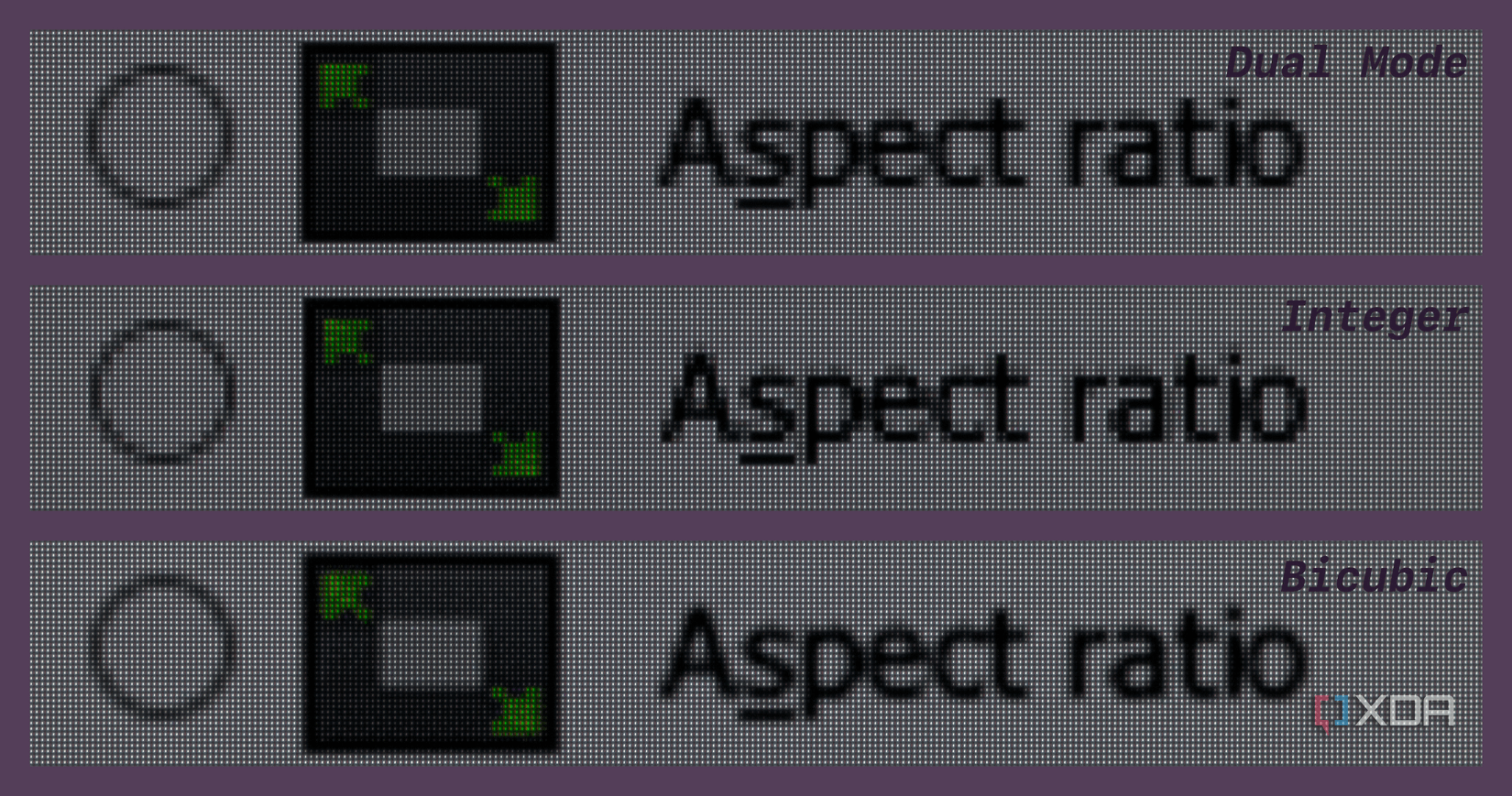
A comparison of the Dual Mode 1080p compared with other upscaling methods.
While you can find dual-mode monitors featuring 4K 180Hz and 1080p 360Hz modes too, most models you’ll come across are the 4K 240Hz and 1080p 480Hz type. These models allow gamers to use a high-refresh-rate and a higher-refresh-rate mode, depending on the type of game or creative application they’re running. However, after experiencing the crisp image quality of 4K on a 4K display, switching to 1080p can come as a shock.
Playing games at 1080p on a 32-inch monitor significantly halves the PPI from 138 to around 69. You might be able to boost your FPS, but the reduction in the image quality isn’t worth it unless you’re playing competitively and don’t care about image sharpness at all. I believe the maximum screen size for 1080p to be around 24 inches, beyond which you begin to see pixelation at close quarters.
Gaming is just one area where you’ll feel the compromise; text clarity is another. If you use your PC for work or are particularly finicky about text sharpness, you’ll want to avoid the 1080p 480Hz mode altogether. The blazing-fast 480Hz refresh rate is incredible, yes, but all the drawbacks of 1080p displays remain.

Related
FHD vs QHD vs UHD: Choosing the right monitor resolution
Shopping for a new monitor? Here’s which resolution to pick between FHD, QHD, and UHD.
4
1440p 240Hz monitors exist
The sweet spot is already available
If the whole argument behind dual-mode monitors is to enjoy both high resolutions and high refresh rates, then a trusted 1440p 240Hz monitor already makes that happen. This sweet spot ensures you neither need a high-end GPU to power 4K nor need to suffer poor image quality at 1080p. The 240Hz refresh rate is incredibly fast and smooth for both single-player games as well as competitive multiplayer titles.
The hardware required to drive 200+ FPS, even at 1440p, needs to be beefy, but still less powerful than the one needed to push 4K at 240Hz. The difference between 4K and 1440p, especially on a 27-inch (and not 32-inch) screen isn’t as stark as that between 4K and 1080p on a 32-inch display. 1440p is still the best resolution for gaming, and with the help of advanced upscaling technologies like DLSS, FSR, and XeSS, achieving high FPS is more than possible.

Related
5 reasons the new 27-inch 4K OLED 240Hz monitors are the endgame for gamers
There’s a new ultimate display spec in town — 4K on 27 inches with a 240Hz OLED panel
3
Your GPU doesn’t need the help
You probably have a high-end rig already
If you’re someone considering a premium dual-mode monitor, I’m guessing you already have a high-end graphics card capable of 4K gaming. Your 4K monitor doesn’t need a secondary 1080p 480Hz mode to help the GPU pump out more framerates. Triple-digit FPS at 4K resolution is very much possible on graphics cards like the RTX 4090 and RTX 4080 Super with the help of upscaling and frame generation, even with ray tracing enabled in the most demanding titles like Cyberpunk 2077 and Alan Wake 2.
Even if your rig is struggling with the 4K 100 FPS standard, dropping from 4K to 1080p, I believe, is not a decent trade-off at all. Getting a 1440p high-refresh-rate monitor is still better than a dual-mode model having a 1080p display. Dual-mode monitors don’t come cheap and don’t fit the setups of most gamers who are looking for a decent gaming monitor. Even for high-end customers, it pays to buy a premium 4K OLED monitor instead of a dual-mode display, if immersion and performance are the priorities.

2
The prices aren’t interesting enough
I would buy a standard high-end monitor
Dual-mode monitors are only about a year old, so the prices haven’t come down enough to make heads turn. At the $1,000 mark, there are far more compelling gaming monitors available on the market. Whether you’re a fan of OLEDs, QD-OLEDs, Mini-LEDs, or ultrawides, the most popular models are way more interesting than the gimmicky, dual-mode models.
For many gamers, the best monitor is often within the $300-$500 price range, hence considering 4K 240Hz/1080p 480Hz monitors for a grand is out of the question. Until dual-mode monitors get considerably cheaper, standard high-end monitors will continue to attract more attention, and consequently, more consumers.

Related
4 reasons I would still buy an OLED monitor despite the tradeoffs
OLED monitors aren’t perfect (yet) but I’m willing to live with the tradeoffs for the superior experience
1
You probably have a strong preference
Superior image quality or high framerates
The biggest problem I see with dual-mode monitors is the incredibly small niche of consumers they’re targeting. The number of people who want their 4K high-refresh-rate screen to double up as a perfect 1080p esports champ isn’t that big. Most people have a strong preference for one camp — silky-smooth images or blazing-fast motion. They pick a lane and stick to it instead of looking for a dual-purpose monitor.
The choice doesn’t have to be lopsided either, as we saw above. The 1440p 240Hz displays strike the right balance between image quality and refresh rate to satisfy members of both camps. And if you’re a hardcore gamer splurging on a dual-mode monitor just to be able to jump from 1080p to 4K resolution for your creative workloads, you would be better off buying a dedicated professional monitor for that purpose.
That’s the thing — dual-mode monitors don’t entirely satisfy any single type of user. It’s always better to spend your money on a dedicated device built for your use case instead of trying to do multiple things at once. I prefer image quality over insanely high framerates, which is why my 1440p 144Hz monitor is going to last me a few more years. Dual-mode monitors might just be a passing fad.

Related
Visual fidelity vs framerate: What should you you prioritize?
Does image quality matter more than the smoothness of a game?
Gamers are good with “single-mode” monitors
Dual-mode monitors appear to be solving a problem that doesn’t exist. If I want to game at 360–480 FPS, I’ll get a 1080p 480Hz monitor. And if all I need is the sharpest image with a decently high refresh rate, 1440p 240Hz monitors are always there. The attempt to shoehorn a jack-of-all-trades monitor is only creating compromises, that too after spending the same amount as standard high-end monitors.
#reasons #shouldnt #buy #dualmode #monitor
source: https://www.xda-developers.com/you-dont-need-dual-mode-monitor/


