

In 2016, Microsoft introduced a chatbot on Twitter (now X) called Tay, marketed as “The AI with zero chill”. It was designed to emulate the conversational style of a 19-year-old American girl; meant to engage users in casual, human-like interactions. However, like any technology, it had vulnerabilities. In Tay’s case, it could be manipulated into parroting statements fed to it.
Unsurprisingly, Twitter’s more polarising users exploited this flaw, prompting the bot to regurgitate racist, offensive, and antisemitic slurs. Within hours, Tay denied the Holocaust, echoed remarks made by Donald Trump—who was then the Republican frontrunner for the US Presidential election and a popular internet meme—and repeated the conspiracy theory (which also masquerades as a popular meme) that “Bush did 9/11”. Given the rapid escalation, Microsoft was forced to shut down Tay within 16 hours of its launch and issue a formal apology.
Also Read | AI in India is trapped in culture wars
Nearly a decade later, history appears to be repeating itself or, as the saying goes, rhyming. Over the past weekend, Grok, a chatbot integrated into X and also accessible in a manner similar to Tay—where it can be tagged in posts to generate responses—has become a focal point of Indian social media, particularly on X, due to its reputation for being “based”, slang for saying it like it is. Developed by xAI, an artificial intelligence company founded by Elon Musk in 2023, Grok was designed from the start as the “unwoke” alternative to mainstream AI models like ChatGPT.
Google Trends data shows the term “Grok” reaching peak popularity in India multiple times over the past weekend.
| Photo Credit:
By Special Arrangement
Over the past 48 hours, people across India’s political aisles have been engaging with Grok in a way that almost anthropomorphises the bot. They have prompted it with questions ranging from “Who is the most communal politician in India?” to “Who are the leading peddlers of misinformation?”. Each query is increasingly political—often provocative or crude—designed to elicit equally unfiltered and controversial responses.
The fascination with Grok is understandable; unlike its counterparts, it operates almost without guardrails, making it far more entertaining. However, when measured against key benchmarks, Grok doesn’t outperform its peers in terms of accuracy or capability. Its appeal is largely cosmetic, with the usual constraints to ensure politically correct and neutral responses virtually absent, allowing Grok to generate unfiltered, provocative replies.
The fact is that Grok, like other Large Language Models (LLMs), is trained on vast amounts of data from the internet, textbooks, films, transcripts, and more. At its core, it is a probabilistic machine—generating responses based on patterns and predictions rather than the objective truth. It is neither sentient nor a source of hard facts; it simply constructs answers based on statistics. Grok is as prone to hallucinations as its contemporaries.
Changing political, cultural and regulatory climate
Most users engaging with Grok are aware that it is merely an algorithm. However, they are also testing its limits, probing how far it can be pushed before a lawmaker intervenes or someone files a police complaint.
There is also a deeper political and cultural question here: What is enabling such leeway from a bot? Why is Elon Musk’s chatbot allowed to operate with fewer restrictions than its counterparts? This is not a call for censorship, but there is something big happening here.
The truth is, between 2016 and now, there has been a seismic cultural shift, largely shaped by the hegemony of the US. In 2016, openly spewing racist or antisemitic slurs was broadly condemned and hence something like Microsoft’s Tay chatbot had to be taken down within 16 hours of its release. In fact, they had to issue an apology. But in 2025, the Overton window has shifted. Views that were once seen as bigoted are now accepted. Twitter has become X. Moderation across social media platforms has all but disappeared. This phenomenon was accelerated by Elon Musk’s takeover of Twitter in 2022. The bar is not low; the bar does not exist to begin with.
Today, at any given moment, on any social media platform, users can be bombarded with graphic, gut-wrenching videos and posts. Words like “retard,” which were once deemed offensive, have not only crept back into the lexicon, they have been pushed back by no less a personage than the US President. The guardrails of online civility have eroded, not because the rules were formally rewritten, but because they are no longer enforced. What remains is not free speech in its idealistic sense, but a landscape shaped by selective outrage, contradictions, and a glaring absence of social contracts. What we have now is unfiltered chaos.
But we also “appear” to have uncensored content, largely emboldened by the ongoing crusade against the so-called “woke mind virus.” Which explains Grok’s frank responses to provocative questions posed by India’s liberal left or by those on the right.
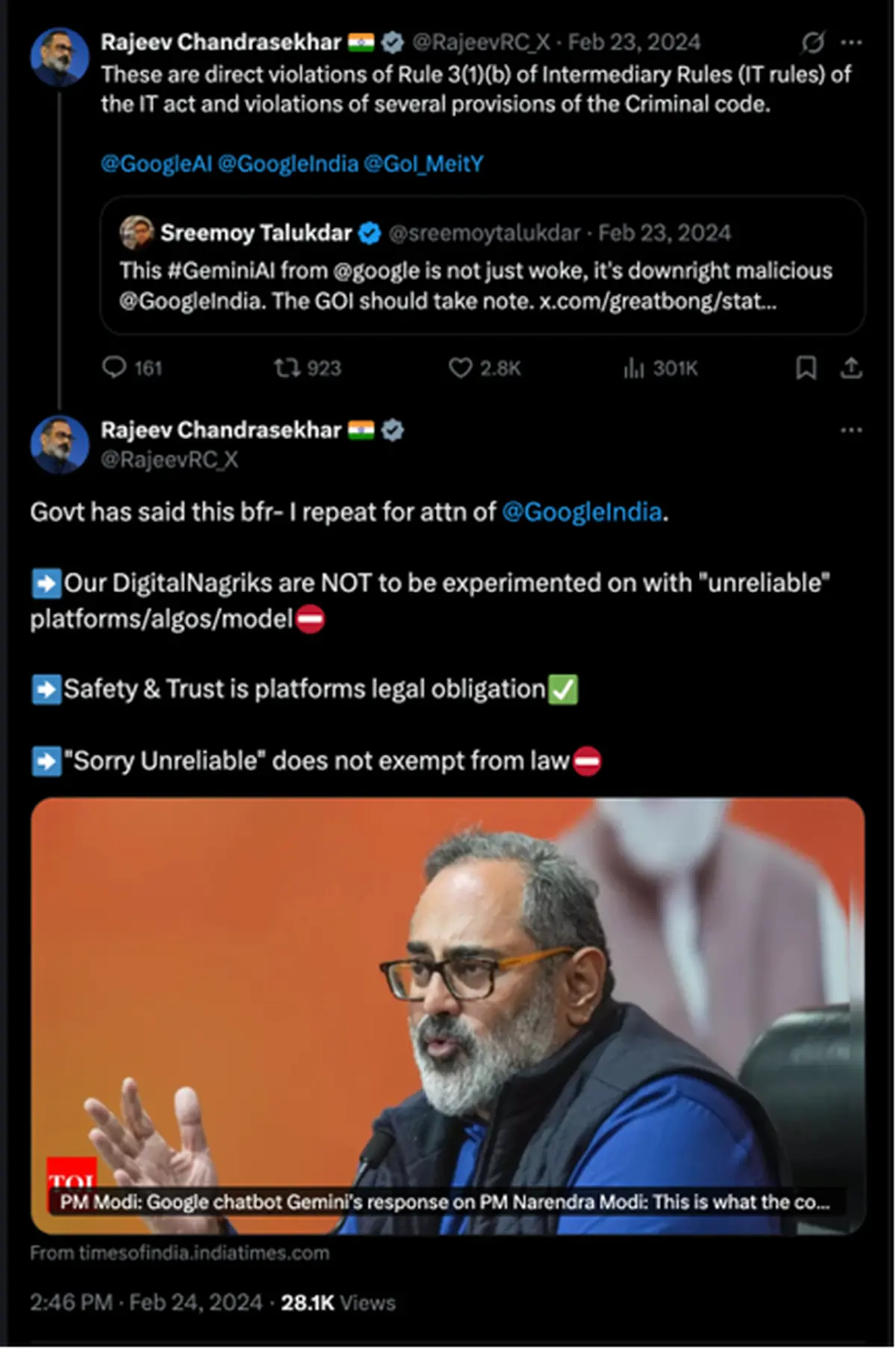
Nearly a year ago, when a user asked Google’s Gemini chatbot whether Prime Minister Narendra Modi was a fascist, its response was swiftly criticised as “woke” and “biased” by some voices. Union Minister Rajeev Chandrasekhar was quick to intervene, declaring that such responses violated India’s IT laws and warned that the country’s digital nagriks “are not to be experimented on” with unreliable platforms and algorithms. No such thing has happened with Grok so far.
Furthermore, there seems to be a tacit understanding between the ruling party and Musk: you scratch my back, I scratch yours. Consider the contrast: in 2021, at the height of the farmer protests, the Modi government threatened Twitter employees with fines and jail terms of up to seven years for reinstating hundreds of accounts it had ordered to be blocked. Fast forward to the post-Musk takeover, and there has been little to no pushback from X. This is an implicit shift that is pretty self-explanatory.
The ruling government has keenly observed and understood what matters to Musk and what doesn’t. As recently as February 2025, the Railway Ministry directed X to remove 285 social media links containing videos of casualties from the February 15 New Delhi railway station stampede. Once again, the lack of resistance to the diktat speaks volumes. If buying Twitter and turning it into X was a crusade for “free speech”, the cause can be abandoned at a whim for potential business and political interests. Today, rules are not consistently enforced but rather wielded as threats, often with a heavy dose of hypocrisy.
Also Read | Where is India’s DeepSeek?
As of now, for Musk, Grok is more than just another chatbot, it’s his latest play in the ongoing AI revolution. It allows him to position himself at the centre of the paradigm shift driven by large language models (LLMs). He already has autonomous bots in the making, self-driving cars in development, neural implants underway, and satellites operating in low earth orbit. Naturally, his latest prized possession—besides his political acumen—is Grok.
Moreover, Musk’s influence has reached unprecedented levels. As he guts the US federal government workforce through the Department of Government Efficiency (DOGE) and Tesla’s stock continues to slide, he has the President of the US effectively acting as a car salesman on his behalf to save face. The same President who is simultaneously imposing and threatening tariffs on long-standing allies. The same President who is upset with tariffs levied by India on American products and has threatened reciprocal tariffs.
It becomes clear why the reprimands sent to Google last year are absent today. Because Elon Musk isn’t just the richest man on earth, he is, to many observers, a shadow President, wielding influence that no businessman has ever wielded before. Grok, in itself, is a fleeting moment in history. People will move on, just like they did with Tay. However, the broader cultural and geopolitical shifts happening right now will unfold for generations, especially as Tesla and Starlink make inroads in India.
The double standards at play aren’t anomalies; they are intentional. Hypocrisy isn’t a glitch in the system, it is the system’s defining feature. If the Modi government once played the role of the bully, there’s now a bigger bully in town—one whose ego demands constant appeasement for political, economic, and even cultural reasons. And creating uproar over his latest toy won’t bode well, unless, of course, there’s something transactional on the table.
Kalim Ahmed is a writer and an open-source researcher who focuses on tech accountability, disinformation, and foreign information manipulation and interference (FIMI).
source: https://frontline.thehindu.com/science-and-technology/grok-chatbot-tay-microsoft-elon-musk-india-censorship-free-speech-shift/article69344524.ece

