

A feeding female Anopheles gambiae mosquito, a known vector for malaria.
| Photo Credit: James Gathany/CDC/AP
A new way to to combat antimalarial drug resistance
DESPITE the availability of many drugs and preventive strategies to treat or halt the spread of malaria, it continues to infect more than 250 million people annually, the majority of whom are children under the age of 5. Compounding the problem is the increasing drug resistance of the malarial parasite to nearly every available antimalarial treatment.
Researchers from Children’s Hospital of Philadelphia (CHOP), led by Sesh A. Sundararaman, who were studying how to combat antimalarial drug resistance, say they have discovered a key process that could provide a new approach for antimalarial treatment. The findings, published in Proceedings of the National Academy of Sciences, provide new insights into how to design antimalarial drugs that treat patients more effectively.
Many potential drugs fail in the development stage itself because they are poorly absorbed in the gastrointestinal tract or are absorbed and removed from the body too quickly. However, one promising strategy is the use of prodrugs, which improve a drug’s ability to be absorbed or reach its target. Prodrugs can get through the layers of protection offered by membranes of the parasite and host cells, and they also have a drug “warhead” that effectively kills the parasite, thus enabling a more targeted attack.
However, prodrugs are inactive and must be activated, typically by an enzyme, to achieve the desired effect. CHOP researchers set out to understand how antimalarial prodrugs are activated. In the process of the study, the researchers identified a human enzyme, acylpeptide hydrolase (APEH), that strongly activates multiple antimalarial prodrugs known as lipophilic ester prodrugs.
The enzyme is normally found in red blood cells. In the case of malaria, the enzyme is taken into the parasite’s cytoplasm where APEH has been found to retain its activity. The researchers’ findings suggest that APEH activates antimalarial prodrugs within the parasite, greatly increasing the potency of the lipophilic ester prodrugs.
While this finding was unexpected, the researchers note that it could help design “resistance-proof” prodrugs. Mutations in prodrug-activating enzymes are a common mechanism for antimicrobial drug resistance. However, the parasite would be unable to mutate a host enzyme, decreasing the likelihood that drug resistance could develop by this mechanism.
“Based on our findings, we believe that leveraging an internalised host enzyme would circumvent these issues and enable the design of prodrugs with higher barriers to drug resistance,” said Sundararaman. “This might eventually lead to the development of parasite- or bacteria-specific prodrugs that are less reliant on specific enzymes.”
Also Read | The battle against malaria on World Malaria Day and beyond
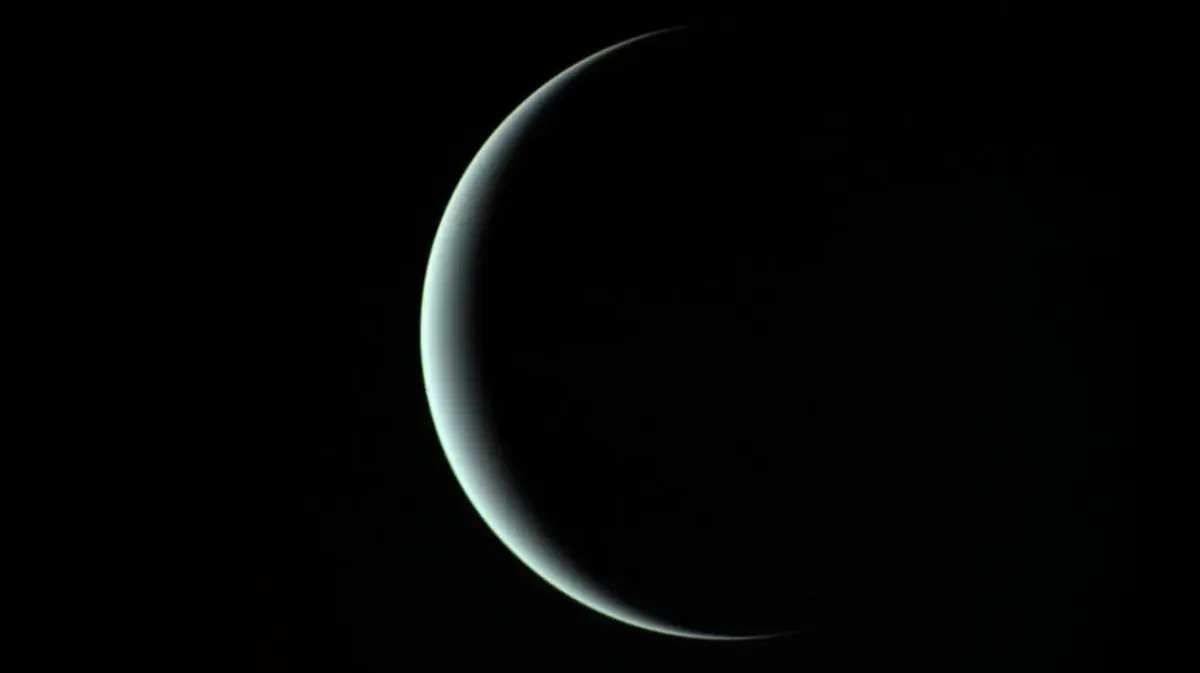
The Voyager 2 spacecraft’s 1986 photograph of Uranus.
| Photo Credit:
JPL/NASA
Uranus is not as odd among the gas giant as previously thought
WHEN NASA’s Voyager 2 went past Uranus on January 24, 1986, the spacecraft detected no significant excess heat from the planet, making it seemingly unlike the other three gas giants: Jupiter, Saturn, and Neptune. However, two studies based on new observations from space- and ground-based telescopes—as yet unpublished in any peer-reviewed journal—have reported that Uranus emits more energy than it gets from the sun just as the other giants. The preprints of the two reports were posted in late February in the online preprint repository arXiv.org.
“Uranus is not as odd as we thought it was,” said the planetary scientist Patrick Irwin of the University of Oxford, the lead author of one of the studies. According to both teams, Uranus, whose orbital period is 84 years, reflects a bit more sunlight into space than Voyager had found. This means that the sun heats the planet less than previously thought, suggesting that Uranus must generate some heat to explain its temperature.
“Uranus does indeed have internal heat,” said Liming Li of the University of Houston and a co-author in the second study. This heat is presumably left over from the planet’s birth.
While the first study has estimated this excess over the energy received from the sun to be 15 per cent, the second study’s estimate is 12.5 per cent, making the two results mutually consistent. However, Uranus is still an outlier among the giants because the others emit more than twice as much energy as they receive from the sun. The reason for Uranus being so subdued is not known.
And, unlike the others, Uranus rotates on its side, with an axial tilt of 98 degrees compared with 3 degrees for Jupiter, 27 degrees for Saturn, and 28 degrees for Neptune. Planetary scientists believe that that some massive object probably knocked Uranus over. The impact may then have brought up hot material from the interior and caused Uranus to lose much of its heat during its youth.
Also Read | Into the unknown

A tiny anvil made of sapphire squeezes metal atoms into ultrathin 2D sheets.
| Photo Credit:
Nature
New technique to forge large 2D metal sheets
TAKING inspiration from ancient techniques, a Chinese research group, led by Guangyu Zhang of the Chinese Academy of Sciences, has developed a method to forge relatively large sheets of metal that are just atoms thick. The method can be applied to any metal with a low melting point, and the team has used it to make 2D sheets of bismuth, gallium, indium, lead, and tin. This achievement was reported in a recent issue of Nature.
The properties of 2D materials are quite different from those of the bulk material. For example, graphene, which has been around for over a decade now, is a 2D sheet of carbon extracted from graphite and is mechanically tougher and a better conductor of heat and electricity than graphite. Since the first studies of graphene in 2004, many atomically thin 2D materials have been made. However, most of them, including graphene, are generated by peeling sheets from layered crystalline materials.
Using the same trick with metals has not been that successful as they lack this peelable layered structure, and whenever scientists have tried to create 2D metal sheets out of the bulk, these have been unstable. However, last April, Lars Hultman and colleagues reported a method by which they were able to make 2D flakes of gold nanometres wide, called “goldene”.
Zhang was apparently inspired by a video of forging sheets of copper, where the metal is heated in a furnace, then hammered and squeezed on a large anvil. But adapting the technique to work at nanoscale took the team seven years. The biggest challenge was to find a sufficiently flat anvil to squeeze layers of a certain class of metals known as “van der Waals metals”. The team eventually selected sapphire, which is very hard, and they coated the metal in molybdenum disulfide (MoS2), which is atomically flat.
To make an ultrathin metal sheet, the team heated a droplet of the metal between two sapphire anvils, which were pressed together as the metal cooled. Since MoS2 interacts more strongly with metal than with sapphire, the researchers allowed the material to cool for several hours. Afterwards, they could first peel off the top anvil and extract the resulting MoS2-metal-MoS2 sandwich sheets.
source: https://frontline.thehindu.com/science-and-technology/antimalarial-drug-resistance-prodrugs-apeh-enzyme/article69376399.ece

