

Jared Fischer and Jose Luis Montoya Mira of Oregon Health & Science University have developed a diagnostic test (PAC-MANN) for the early detection of pancreatic cancer.
| Photo Credit: OHSU/Christine Torres Hicks
Cheap nanosensor for early detection of pancreatic cancer
ACCORDING to data, about 0.5 million people have died globally due to pancreatic cancer. This cancer starts in the pancreatic duct, which secretes digestive enzymes. However, detectable symptoms do not show up until the cancer reaches the metastasis stage, when treatment options become limited. Researchers at Oregon Health & Science University (OHSU) have developed a new blood test that could help doctors detect pancreatic cancer before it spreads to other parts of the body, thus potentially improving survival rates against one of the deadliest cancers. Unlike traditional tests, the new test, called PAC-MANN (a protease activity–based assay using a magnetic nanosensor), requires only a tiny blood sample and provides a simple fluorescent read-out, making it a quick and accessible option for routine screening. It detects changes in the activity of protease (an enzyme that breaks down proteins into single amino acids or smaller polypeptides) in the blood, a key indicator of pancreatic ductal adenocarcinoma (PDAC), which is the most common form of pancreatic cancer.
According to the release from OHSU, current tests, which detect sugars such CA 19-9, are good at indicating prognosis but are not sensitive enough for early-stage detection. Recently, an American scientist duo reported a new experimental test that uses a new sugar biomarker for pancreatic cancer called CA1999.STRA and has a 71 per cent efficiency compared with the 44 per cent of the current gold standard test using CA19.9. However, the PAC-MANN test not only detects cancers earlier but also has a 85 per cent efficiency.
“The problem with pancreatic cancer is that we often catch it too late,” said Jared Fischer, a co-author in the research, which was led by Jose Luis Montoya Mira. The work was published in a recent issue Science Translational Medicine. “[Our test] allows for a more robust and less invasive screening, unlike an endoscopic ultrasound and other liquid biopsy tests that require large volumes of blood, thus allowing our test to be performed more frequently for earlier detection,” Mira said.
The diagnostic is a rapid, non-invasive assay based on a fluorescently labelled protease-sensitive peptide coupled to a magnetic nanosensor. The researchers place millions of nanosensors in a tiny sample of blood. If metalloproteinases (proteases of a kind) are present, and active, they will chop the peptide in the nanosensors, releasing the fluorescent molecule. Researchers can then use a magnet to suck out all the unchopped nanosensors and measure how many chopped fluorescent particles are left. The assay has been optimised to detect all stages of PDAC.
The researchers developed the test using frozen blood samples from 356 patients who had pancreatic cancer or were at high-risk for cancer or were controls. The test was able to correctly distinguish patients with pancreatic cancer from healthy patients and those with non-cancerous pancreatic issues 98 per cent of the time. It also helped spot early-stage cancer with 85 per cent accuracy when used along with the CA 19-9 test. Their findings also showed that PAC-MANN could track how well treatments were working.
Also Read | A new vaccine for pancreatic cancer
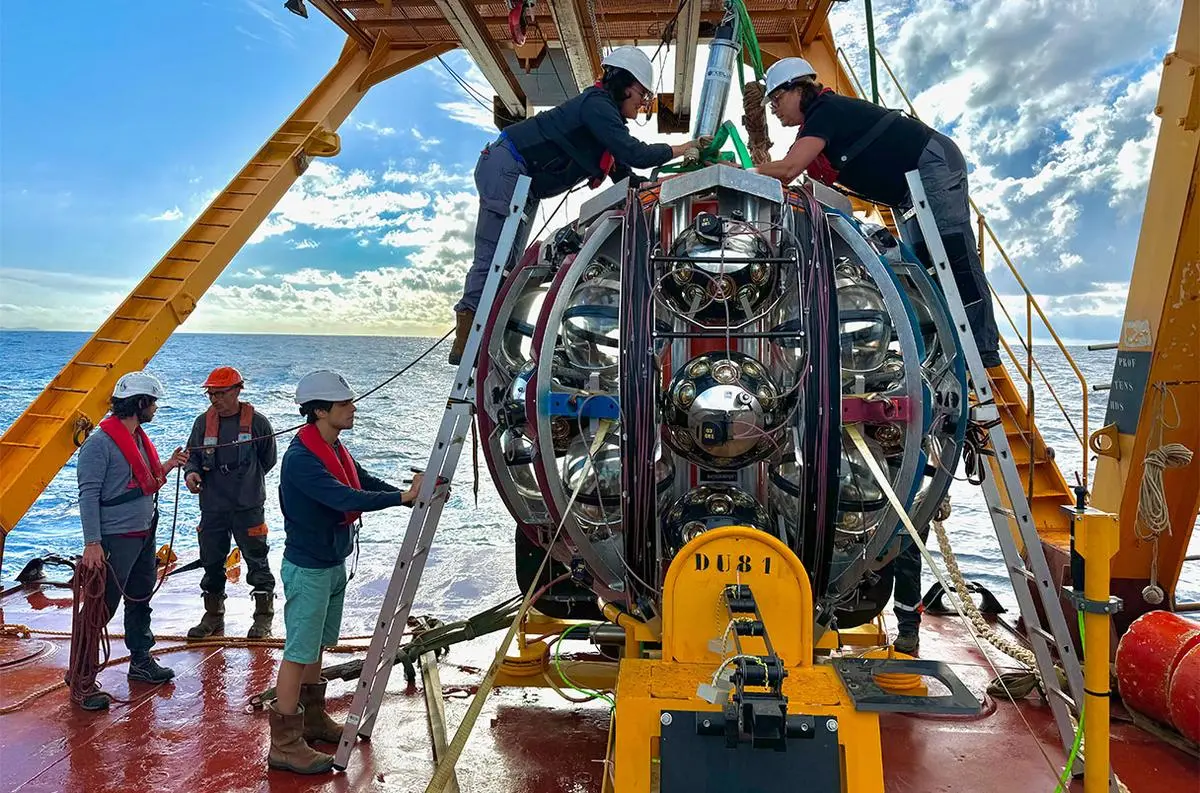
These light detectors are deployed in strings rising from the seabed to form the cubic kilometre neutrino telescope, KM3NeT.
| Photo Credit:
KM3NeT Collaboration
Record-smashing ultra-high-energy neutrino detected
AN extraordinary, perhaps a cosmogenic, event consistent with a neutrino with an estimated energy of about 220 petaelectronvolts (PeV), that is, 220 × 1015, or 220 million billion electronvolts, was detected on February 13, 2023, by the ARCA detector of the yet-to-be-completed kilometre cubic neutrino telescope (KM3NeT) deep in the Mediterranean sea. This event, named KM3-230213A, is the most energetic neutrino ever observed and provides the first evidence that neutrinos of such high energies are produced in the universe. The details of this discovery by the international scientific collaboration of KM3NeT were published in Nature on February 12, 2025, after two years of painstaking analysis of the experimental data.
The detected event was a single muon with the huge energy of about 120 PeV, which crossed the entire detector and induced signals in more than one-third of the active sensors. The inclination of its trajectory, combined with its enormous energy, has provided the grounds for the compelling argument that the muon originated from a cosmic neutrino interacting in the proximity of the detector.
“KM3NeT has begun to probe a range of energy and sensitivity where detected neutrinos may originate from extreme astrophysical phenomena,” said Paschal Coyle, the KM3NeT spokesperson at the time of the detection and a researcher at Centre de Physique des Particules de Marseille of the Centre National de la Recherche Scientifique, France. “This first-ever detection of a neutrino of hundreds of PeV opens a new chapter in neutrino astronomy and a new observational window on the Universe.”
The high-energy domain of the universe comprises cataclysmic events such as accreting supermassive black holes at the centre of galaxies, supernova explosions, and gamma-ray bursts. These powerful cosmic accelerators generate streams of cosmic rays, some of which may interact with matter or photons around the source, to produce neutrinos and photons. During their travel across the universe, some of the most energetic cosmic rays may also interact with photons of the cosmic microwave background radiation and produce extremely energetic “cosmogenic” neutrinos.
Neutrinos are one of the most mysterious of elementary particles: they have no electric charge and almost no mass (they are over a million times lighter than the electron) and interact only weakly with matter. They are special cosmic messengers, bringing unique information on the mechanisms involved in the most energetic phenomena. Although they are the second most abundant particle in the universe after photons, their weak interaction with matter makes them hard to detect and requires enormous detectors.
The KM3NeT neutrino telescope, currently under construction about 80 km from the coast of Portopalo di Capo Passero, Sicily, is a giant deep-sea instrument distributed across two detectors, ARCA and ORCA, at a depth of 3,450 m. In its final configuration, KM3NeT will occupy a volume of more than 1 cubic km. KM3NeT uses seawater as the interaction medium for neutrinos. Its high-tech optical modules detect the Cherenkov light, a bluish glow that is generated during the propagation through the water of the ultra-relativistic particles produced in neutrino interactions. The present discovery was made possible with just one-tenth of its final configuration.
This ultra-high energy neutrino may have originated directly from one of the powerful cosmic accelerators. Alternatively, it could be the first detection of a cosmogenic neutrino. However, with a single neutrino event it is difficult to pinpoint its origin. Future detection of more such events will enable a clearer picture.
Also Read | Omega Centauri’s black hole, record-energy neutrino, and GaN semiconductors for nuclear reactors
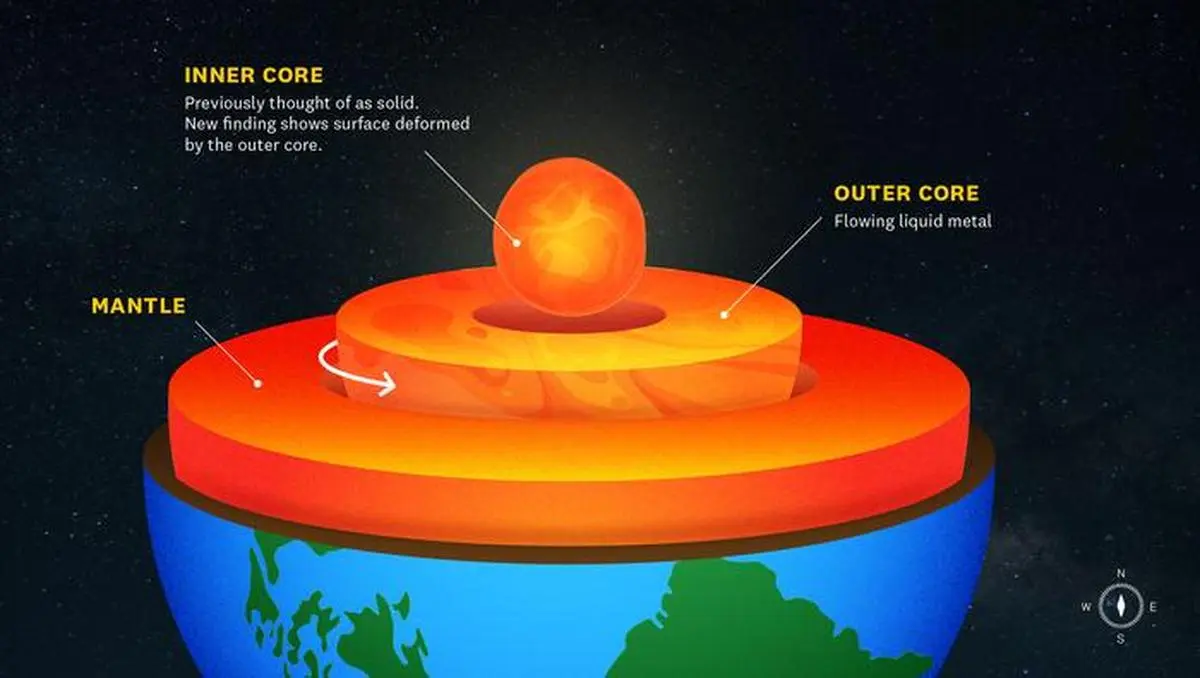
The earth’s internal layers including the mantle, outer core and inner core. New research shows the inner core undergoes structural transformation likely caused by outer core disturbance.
| Photo Credit:
USC Graphic/Edward Sotelo
Earth’s inner core may be changing its shape
THE earth’s inner core, which until now was widely believed to be a solid sphere, is located about 5,000 km below the earth’s surface and is anchored by gravity within the molten liquid outer core. According to a new study by scientists of the University of Southern California (USC), the surface of the inner core may be changing. The work was published in a recent issue of Nature Geoscience.
Geoscientists have for a long time debated the changing inner core. However, much of the research has been focussed on assessing the core’s rotation. The original aim of the USC scientists, too, was to further delineate the slowing of the inner core. “[We] didn’t set out to define the physical nature of the inner core,” said John Vidale of the USC, who is the principal investigator of this new study.
“But as I was analyzing multiple decades’ worth of seismograms, one dataset of seismic waves curiously stood out from the rest,” Vidale said. “Later on, I’d realize I was staring at evidence the inner core is not solid.” The study utilised the seismic waveform data of 121 repeating earthquakes that occurred between 1991 and 2024 at 42 locations near Antarctica’s South Sandwich Islands. “At first the dataset confounded me,” Vidale said. Only when the research team improved the resolution technique did it become clear that the seismic waveforms represented additional physical activity of the inner core.
“What we ended up discovering is evidence that the near surface of Earth’s inner core undergoes structural change,” he said. The finding sheds light on the role topographical activity plays in rotational changes in the inner core—including changes that have minutely altered the length of a day—and may also relate to the inner core’s ongoing slowing. A study the USC scientists published last year showed that the rotation of the core had slowed down around 2010. The physical activity is best explained as temporal changes in the shape of the inner core. The new study indicates that the near surface of the inner core may undergo viscous deformation, changing its shape and shifting at the inner core’s shallow boundary.
The most likely explanation for this, according to the researchers, is interaction between the inner and outer core. “The molten outer core is widely known to be turbulent, but its turbulence had not been observed to disrupt… the inner core on a human timescale,” Vidale said. “What we’re observing in this study for the first time is likely the outer core disturbing the inner core.” Vidale said the discovery opened a door to reveal previously hidden dynamics deep within the earth’s core and may lead to better understanding of the earth’s thermal and magnetic fields.
source: https://frontline.thehindu.com/science-and-technology/nanosensor-detect-pancreatic-cancer-high-energy-neutrino-earth-core-changes/article69229386.ece


