

-
Nvidia GeForce RTX 5080
The RTX 5080 is the new xx80 tier using the Blackwell architecture, which brings GDDR7 to a consumer GPU for the first time. It’s also $300 less than the MSRP of the outgoing RTX 4080, which is better pricing from Nvidia even if the GPU doesn’t meaningfully improve on performance.
Pros & Cons- GDDR7 memory for lots of bandwidth
- Plenty of ray tracing power
- Lower MSRP compared to the card it replaces
- First xx80 card to not beat the outgoing flagship in some time
- Hard to find in stock
- 16GB VRAM isn’t enough for its tier
-
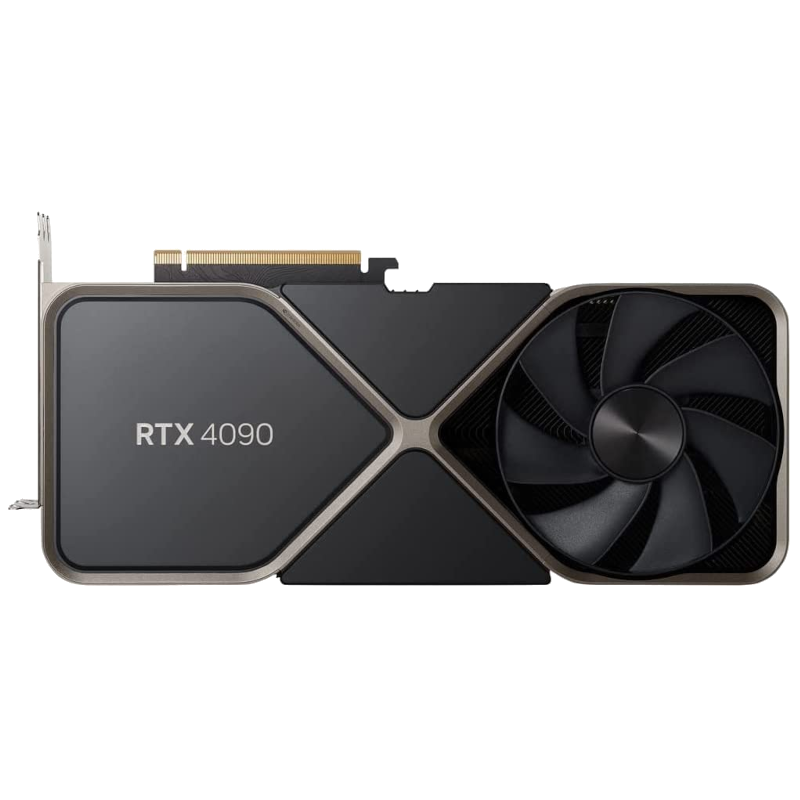
Nvidia GeForce RTX 4090 Founders Edition
The outgoing flagship GeForce RTX 4090 is still an absolute beast (if you can find one in stock). Unfortunately, Nvidia stopped production in 2024, so they’re getting harder and harder to find.
Pros & Cons- 24GB of VRAM
- Plenty of CUDA cores
- Good ray tracing performance
- Not being produced any more

Nvidia’s GeForce RTX 50 series is here, and if you were lucky to get one of the best GPUs in the brief time they were available, you know you’ll be playing DLSS-enhanced games as soon as you plug it in. Only the top two from the range are out, which is the usual release cadence for any GPU release. The RTX 5080 joins a long line of XX80 graphics cards from the company, and the general rule is that the new XX80 card is more powerful than the previous flagship. That’s the RTX 4090 in this case, and it’s only fitting if we put that long line of historical facts to the test.

Related
It’s time to accept Nvidia’s “fake frames” might be the new normal
Like it or not, Nvidia’s RTX 50 series shows that AI-generated frames are here to stay
RTX 5080 vs RTX 4090: Price, specs & availability
The new lieutenant squares up against the previous captain
The Nvidia GeForce RTX 5080 launched with an MSRP of $1,000, the same price as the outgoing RTX 4080 Super. It’s designed for 1440p and 4K gaming, especially because it can use DLSS frame generation to create up to three AI-generated frames per rasterized frame made from the traditional rendering process. The new Blackwell architecture powers it with 10,752 shader units and 84 ray tracing cores and the inclusion of a PCIe 5.0 interface for the first time on a consumer GPU.
The Nvidia GeForce RTX 4090 was the flagship of the last generation, powered by the Ada Lovelace architecture. It had an MSRP of 1,600 when it launched in 2023, has 16,384 shader units and 128 ray tracing cores, and is out of production as of 2024, so you’ll be lucky to find any new units anywhere near the MSRP.
-
Nvidia GeForce RTX 5080 Nvidia GeForce RTX 4090 Shader Units 10,752 16,384 Ray Accelerators/Cores 84 128 Base Clock Speed 2,295 MHz 2,235MHz Boost Clock Speed 2,617 MHz 2,520MHz Memory Capacity 16 GB GDDR7 24GB GDDR6X Memory Bus 256-bit 384-bit Memory Bandwidth 960 GB/s 1,008GB/s Power Draw 360 W 450W Architecture Blackwell Ada Lovelace
Architecture
Blackwell takes over from Ada
The Nvidia GeForce RTX 5080 comes with a new architecture, Blackwell. This builds on the Ada Lovelace architecture used in the GTX 4090, with two key new features. While Ada had single frame generation, which uses the Tensor cores for AI-generating one frame per raster frame when enabled, the RTX 5080 can generate up to three frames per raster frame, drastically increasing frame rates at higher resolutions without incurring much penalty for latency or system resources.
The other key feature, DLSS 4, is mostly backward compatible with the RTX 40 series, with some features also working on the RTX 30 and RTX 20 cards. It includes a new deep learning anti-aliasing (DLAA) model for fewer jaggies, enhanced DLSS Super Resolution for rendering at a lower resolution and upscaling to your monitor’s native resolution, and DLSS ray reconstruction for better lighting effects with ray traced titles.

Source: Remedy Entertainment
For the first time, the RTX 5080 uses GDDR 7, which has 16GB of speedy memory and a 256-bit memory bus, which means 960GB/s of memory bandwidth for the new GPU. This is fast compared to the 24GB of GDDR6X in the RTX 4090, which manages 1,008GB/s out of its wider 384-bit memory bus, but the larger VRAM will make the older card better for AI models or particularly demanding games.

Related
Nvidia GeForce RTX 4090 review: The untouchable king of performance
There is no other graphics card like the Nvidia GeForce RTX 4090. Its power is unmatched, as is its size and its power consumption.
Performance and power
Disappointing showing from the RTX 5080 here, but it is cheaper

There’s no easy way to say this. Without more CUDA cores, the RTX 5080 is always going to lose against the RTX 4090. It’s just a question of by how much. The saving grace here is that the difference is less than the % difference in either price or power usage. While we haven’t got our samples yet to test, other outlets have been busy over the last two weeks, and the picture shows that the RTX 4090 is roughly 20% faster in pure raster performance than the RTX 5080.

If you mostly play older games, the RTX 4090 is easily the one to go for, if you can find it in stock anywhere. When DLSS, particularly Multi Frame Generation, is involved, the two GPUs are at a dead heat. Plus, the RTX 4090 uses up to 450W of power, while the RTX 5080 uses up to 360W. That alone might be the decider, as not everyone has a powerful PSU or wants to use that much power every time they play a game.

Related
3 reasons why the Nvidia GeForce RTX 5080 is better than an RTX 4080
Looking to see if the RTX 5080 is better than the RTX 4080? It is, but here’s why.
RTX 5080 vs RTX 4090: The student doesn’t quite surpass the master
For those of you who want to play DLSS-enhanced games, there’s no question that the GeForce RTX 5080 is the better option. It might not be as powerful in pure raster performance, and the 16GB of VRAM might run into issues as games get more resource-hungry, but it’s $600 cheaper. It’s also nearly 100W less power-hungry, has a better cooler, and, most importantly—is being actively produced. Whether it’s good value is very dependent on the games and workloads you want to throw at it, but it’s a viable option for upgraders if you have an RTX 30 series or earlier.

Nvidia GeForce RTX 5080
If you can find one in stock, the Nvidia RTX 5080 is a powerful GPU for ray traced games. It’s also $300 cheaper than the RTX 4080 was, making it (slightly) better value.
If you run AI workloads or play older games, the RTX 4090 is going to be more suited to your needs. The snag is that Nvidia stopped production in 2024, to dry up stock before the RTX 50 series launch. If you can find one near or around MSRP, it’s a cracking deal still, and will last you for many years to come until games need more than 24GB of VRAM.

Nvidia GeForce RTX 4090
The outgoing flagship GeForce RTX 4090 is still an absolute beast (if you can find one in stock). Unfortunately, Nvidia stopped production in 2024, so they’re getting harder and harder to find.
#Nvidia #GeForce #RTX #flagship #rules
source: https://www.xda-developers.com/nvidia-rtx-5080-vs-4090/


